mengram-ai
Human-like memory for AI agents — auto-save, auto-recall, cognitive profile. Claude Code hooks, MCP server (29 tools), OpenClaw plugin, semantic/episodic/procedural memory. Free open-source Mem0 alternative.
pinned to #5a0c0e2updated 3 months ago
Ask your AI client: “install mcps/mengram-ai”.
Requires the metahub MCP server installed in your client. Set up MCP.
mh install mcps/mengram-aimetahub onboarded this repo on the author's behalf.
If you own github.com/alibaizhanov/mengram on GitHub, claim the listing to take over publishing. Your claim preserves the existing eval history and badges; only the curator label is replaced with verified-publisher on your next publish.
Stars
178
Last commit
3 months ago
Latest release
published
- #agent-memory
- #ai-agents
- #ai-memory
- #claude-desktop
- #cognitive-architecture
- #cohere
- #cursor-ai
- #episodic-memory
- #knowledge-graph
- #letta-alternative
- #llm-memory
- #mcp-server
- #mem0-alternative
- #model-context-protocol
- #multilingual-embeddings
- #pgvector
- #procedural-memory
- #python
- #rag
- #semantic-search
Automated checks the publisher passed at publish time — structure, docs, safety, and whether the artifact behaves as claimed.5a0c0e2· 3 months ago
Behavioral checks haven't run yet: the sandbox couldn't execute this artifact (it may need credentials we don't provide, or an unsupported build). An environment limit, not a verdict.
Maintenance
2 passed1 warningCI configuration detectedwarn
no CI config found (looked for GitHub Actions, CircleCI, GitLab CI, etc.)
Add a simple workflow (lint + test on PR) — it tells consumers the artifact is built reproducibly.
Recent activity
last push 3 days ago
Tests detected
1 test directory · 4 test files
Release history
1- releasecurrent5a0c0e2warn3 months ago
Contents
pip install mengram-ai # or: npm install mengram-ai
from mengram import Mengram
m = Mengram(api_key="om-...")           # Free key → mengram.io

m.add([{"role": "user", "content": "I use Python and deploy to Railway"}])
m.search("tech stack")                  # → facts
m.ask("what's my tech stack?")          # → synthesized answer + citations
m.episodes(query="deployment")          # → events
m.procedures(query="deploy")            # → workflows that evolve from failures
Native multilingual: ask in Russian, Chinese, Spanish, Japanese — Mengram retrieves and answers across 23 languages (Cohere multilingual embeddings + rerank).
Install in one prompt (any AI tool)
Paste this into Claude Desktop, Cursor, Codex, Claude Code, or Windsurf — the agent reads our setup guide, installs the SDK, configures the MCP server, and verifies the round-trip end-to-end. No terminal context-switching.
Install Mengram for me. Fetch the canonical install guide at
https://mengram.io/agent-install.txt and follow it precisely.
My email is YOUR_EMAIL_HERE.
Works in any agent with shell + file-edit + web-fetch tools. Prefer doing it manually? See the plain-text guide — it's structured for human eyes too.
Claude Code — Zero-Config Memory
Two commands. Claude Code remembers everything across sessions automatically.
pip install mengram-ai
mengram setup              # Sign up + install hooks (interactive)
Or manually: export MENGRAM_API_KEY=om-... → mengram hook install
What happens:
Session Start  →  Loads your cognitive profile (who you are, preferences, tech stack)
Every Prompt   →  Searches past sessions for relevant context (auto-recall)
After Response →  Saves new knowledge in background (auto-save)
No manual saves. No tool calls. Claude just knows what you worked on yesterday.
mengram hook status     # check what's installed
mengram hook uninstall  # remove all hooks
Why Mengram?
Every AI memory tool stores facts. Mengram stores 3 types of memory — and procedures evolve when they fail.
| Mengram | claude-mem | Mem0 | Zep | Letta | |
|---|---|---|---|---|---|
| Semantic memory (facts, preferences) | Yes | Yes | Yes | Yes | Yes |
| Episodic memory (events, decisions) | Yes | Partial | No | No | Partial |
| Procedural memory (workflows) | Yes | No | No | No | No |
| Procedures evolve from failures | Yes | No | No | No | No |
| Cognitive Profile | Yes | No | No | No | No |
| Native multilingual (23 languages) | Yes | No | No | No | No |
| Ask & Citations (synthesized answer) | Yes | No | No | No | No |
| Multi-user isolation | Yes | No | Yes | Yes | No |
| Knowledge graph | Yes | No | Yes | Yes | Yes |
| Claude Code hooks (auto-save/recall) | Yes | Yes | No | No | No |
| LangChain + CrewAI + MCP | Yes | No | Partial | Partial | Partial |
| Import ChatGPT / Obsidian | Yes | No | No | No | No |
| Pricing | Free tier | Free / OSS | $19-249/mo | Enterprise | Self-host |
Get Started in 30 Seconds
1. Install
pip install mengram-ai
2. Setup (creates account + installs Claude Code hooks)
mengram setup
Or get a key manually at mengram.io and export MENGRAM_API_KEY=om-...
3. Use
from mengram import Mengram

m = Mengram(api_key="om-...")

# Add a conversation — auto-extracts facts, events, and workflows
m.add([
    {"role": "user", "content": "Deployed to Railway today. Build passed but forgot migrations — DB crashed. Fixed by adding a pre-deploy check."},
])

# Search across all 3 memory types at once
results = m.search_all("deployment issues")
# → {semantic: [...], episodic: [...], procedural: [...]}
<b>File Upload (PDF, DOCX, TXT, MD)</b>
# Upload a PDF — auto-extracts memories using vision AI
result = m.add_file("meeting-notes.pdf")
# → {"status": "accepted", "job_id": "job-...", "page_count": 12}

# Poll for completion
m.job_status(result["job_id"])
// Node.js — pass a file path
await m.addFile('./report.pdf');

// Browser — pass a File object from <input type="file">
await m.addFile(fileInput.files[0]);
# REST API
curl -X POST https://mengram.io/v1/add_file \
  -H "Authorization: Bearer om-..." \
  -F "[email protected]" \
  -F "user_id=default"
<b>JavaScript / TypeScript</b>
npm install mengram-ai
const { MengramClient } = require('mengram-ai');
const m = new MengramClient('om-...');

await m.add([{ role: 'user', content: 'Fixed OOM by adding Redis cache layer' }]);
const results = await m.searchAll('database issues');
// → { semantic: [...], episodic: [...], procedural: [...] }
<b>REST API (curl)</b>
# Add memory
curl -X POST https://mengram.io/v1/add \
  -H "Authorization: Bearer om-..." \
  -H "Content-Type: application/json" \
  -d '{"messages": [{"role": "user", "content": "I prefer dark mode and vim keybindings"}]}'

# Search all 3 types
curl -X POST https://mengram.io/v1/search/all \
  -H "Authorization: Bearer om-..." \
  -d '{"query": "user preferences"}'
3 Memory Types
Semantic — facts, preferences, knowledge
m.search("tech stack")
# → ["Uses Python 3.12", "Deploys to Railway", "PostgreSQL with pgvector"]
Episodic — events, decisions, outcomes
m.episodes(query="deployment")
# → [{summary: "DB crashed due to missing migrations", outcome: "resolved", date: "2025-05-12"}]
Procedural — workflows that evolve
Week 1:  "Deploy" → build → push → deploy
                                         ↓ FAILURE: forgot migrations
Week 2:  "Deploy" v2 → build → run migrations → push → deploy
                                                          ↓ FAILURE: OOM
Week 3:  "Deploy" v3 → build → run migrations → check memory → push → deploy ✅
This happens automatically when you report failures:
m.procedure_feedback(proc_id, success=False,
                     context="OOM error on step 3", failed_at_step=3)
# → Procedure evolves to v3 with new step added
Or fully automatic — just add conversations and Mengram detects failures and evolves procedures:
m.add([{"role": "user", "content": "Deploy failed again — OOM on the build step"}])
# → Episode created → linked to "Deploy" procedure → failure detected → v3 created
Ask Your Memory (RAG built-in)
m.ask() returns a synthesized answer with citations — not a raw fact list.
Mengram embeds your query, retrieves the top relevant facts, and uses
Cohere Chat to write a grounded answer with native source attribution.
result = m.ask("what programming languages do I use?")

print(result["answer"])
# 'You use Python and Rust. Python is your daily language [1] and
#  Rust is your favorite [2]. You also know Java for enterprise
#  systems [3].'

for cit in result["citations"]:
    print(f'  "{cit["text"]}" → {cit["sources"][0]["fact"]}')
# "Python and Rust" → uses Python daily for backend development
# "favorite [2]"   → Rust is favorite language
# "Java"           → specializes in Java/Spring Boot
Multilingual: ask in any of 23 languages, get an answer in the same language with citations linking back to facts in the original language they were stored. Premium feature (Pro / Growth / Business).
Cognitive Profile
One API call generates a system prompt from all memories:
profile = m.get_profile()
# → "You are talking to Ali, a developer in Almaty. Uses Python, PostgreSQL,
#    and Railway. Recently debugged pgvector deployment. Prefers direct
#    communication and practical next steps."
Insert into any LLM's system prompt for instant personalization.
Import Existing Data
Kill the cold-start problem:
mengram import chatgpt ~/Downloads/chatgpt-export.zip --cloud   # ChatGPT history
mengram import obsidian ~/Documents/MyVault --cloud              # Obsidian vault
mengram import files notes/*.md --cloud                          # Any text/markdown
Integrations
<table> <tr> <td width="50%">Claude Code — Auto-memory hooks
mengram hook install
3 hooks: profile on start, recall on every prompt, save after responses. Zero manual effort.
</td> <td width="50%">MCP Server — Claude Desktop, Cursor, Codex, Windsurf, Cline
{
  "mcpServers": {
    "mengram": {
      "command": "mengram",
      "args": ["server", "--cloud"],
      "env": { "MENGRAM_API_KEY": "om-..." }
    }
  }
}
30 tools for memory management.
</td> </tr> <tr> <td width="50%">LangChain — pip install langchain-mengram
from langchain_mengram import (
    MengramRetriever,
    MengramChatMessageHistory,
)

retriever = MengramRetriever(api_key="om-...")
docs = retriever.invoke("deployment issues")
CrewAI
from integrations.crewai import create_mengram_tools

tools = create_mengram_tools(api_key="om-...")
# → 5 tools: search, remember, profile,
#   save_workflow, workflow_feedback

agent = Agent(role="Support", tools=tools)
OpenClaw
openclaw plugins install openclaw-mengram
Auto-recall before every turn, auto-capture after. 12 tools, slash commands, Graph RAG.
</td> <td width="50%">CLI — Full command-line interface
mengram search "deployment" --cloud
mengram profile --cloud
mengram import chatgpt export.zip --cloud
mengram hook install
Claude Managed Agents — MCP memory for hosted agents
{
  "mcp_servers": [{
    "type": "url",
    "name": "mengram",
    "url": "https://mengram.io/mcp/sse"
  }]
}
30 memory tools via MCP. Docs
</td> <td width="50%">n8n — HTTP nodes for any workflow
POST https://mengram.io/v1/add
POST https://mengram.io/v1/search
No code needed — drag and drop memory into any n8n workflow.
</td> </tr> </table>Multi-User Isolation
One API key, many users — each sees only their own data:
m.add([...], user_id="alice")
m.add([...], user_id="bob")

m.search_all("preferences", user_id="alice")  # Only Alice's memories
m.get_profile(user_id="alice")                 # Alice's cognitive profile
Async Client
Non-blocking Python client built on httpx:
from mengram import AsyncMengram

async with AsyncMengram() as m:
    await m.add([{"role": "user", "content": "I use async/await"}])
    results = await m.search("async")
    profile = await m.get_profile()
Install with pip install mengram-ai[async].
Metadata Filters
Filter search results by metadata:
results = m.search("config", filters={"agent_id": "support-bot", "app_id": "prod"})
Webhooks
Get notified when memories change:
m.create_webhook(
    url="https://your-app.com/hook",
    event_types=["memory_add", "memory_update"],
)
Agent Templates
Clone, set API key, run in 5 minutes:
| Template | Stack | What it shows |
|---|---|---|
| DevOps Agent | Python SDK | Procedures that evolve from deployment failures |
| Customer Support | CrewAI | Agent with 5 memory tools, remembers returning customers |
| Personal Assistant | LangChain | Cognitive profile + auto-saving chat history |
cd examples/devops-agent && pip install -r requirements.txt
export MENGRAM_API_KEY=om-...
python main.py
Use with AI Agents
Mengram works as a persistent memory backend for autonomous agents. Your agent stores what it learns, and recalls it on the next run — getting smarter over time.
from mengram import Mengram

m = Mengram(api_key="om-...")

# Agent completes a task → store what happened
m.add([
    {"role": "user", "content": "Apply to Acme Corp on Greenhouse"},
    {"role": "assistant", "content": "Applied successfully. Had to use React Select workaround for dropdowns."},
])
# → Extracts: fact ("applied to Acme Corp"), episode ("Greenhouse application"),
#   procedure ("React Select dropdown workaround")

# Next run → agent recalls what worked before
context = m.search_all("Greenhouse application tips")
# → Returns past procedures, failures, and successful strategies

# Report outcome → procedures evolve
m.procedure_feedback(proc_id, success=False,
                     context="Dropdown fix stopped working")
# → Procedure auto-evolves to a new version
Works with any agent framework — CrewAI, LangChain, AutoGPT, custom loops. The agent just calls add() after actions and search() before decisions.
Self-Hosted (Ollama)
When running locally with Ollama, use models with 8B+ parameters and 8K+ context window. The extraction prompt is ~4,000 tokens — smaller models will hallucinate or mix examples with real data.
| Model | Parameters | Works? |
|---|---|---|
llama3.1:8b | 8B | Yes |
mistral:7b | 7B | Yes |
gemma2:9b | 9B | Yes |
llama3.1:70b | 70B | Best |
phi4-mini:3.8b | 3.8B | No — context too small |
API Reference
| Endpoint | Description |
|---|---|
POST /v1/add | Add memories (auto-extracts all 3 types) |
POST /v1/add_text | Add memories from plain text |
POST /v1/add_file | Upload file (PDF, DOCX, TXT, MD) — vision AI extraction |
POST /v1/search | Semantic search |
POST /v1/search/all | Unified search (semantic + episodic + procedural) |
GET /v1/episodes/search | Search events and decisions |
GET /v1/procedures/search | Search workflows |
PATCH /v1/procedures/{id}/feedback | Report outcome — triggers evolution |
GET /v1/procedures/{id}/history | Version history + evolution log |
GET /v1/profile | Cognitive Profile |
GET /v1/triggers | Smart Triggers (reminders, contradictions, patterns) |
POST /v1/agents/run | Memory agents (Curator, Connector, Digest) |
GET /v1/me | Account info |
Full interactive docs: mengram.io/docs
Quota Headers
Every authenticated response includes usage headers:
| Header | Description |
|---|---|
X-Quota-Add-Used | Add calls used this month |
X-Quota-Add-Limit | Add calls allowed this month |
X-Quota-Search-Used | Search calls used this month |
X-Quota-Search-Limit | Search calls allowed this month |
SDKs expose this via .quota:
m.search("test")
print(m.quota)  # {"add": {"used": 5, "limit": 30}, "search": {"used": 12, "limit": 100}}
Community
- GitHub Issues — bug reports, feature requests
- GitHub Discussions — show your use case, ask questions
- API Docs — interactive Swagger UI
- Examples — ready-to-run agent templates
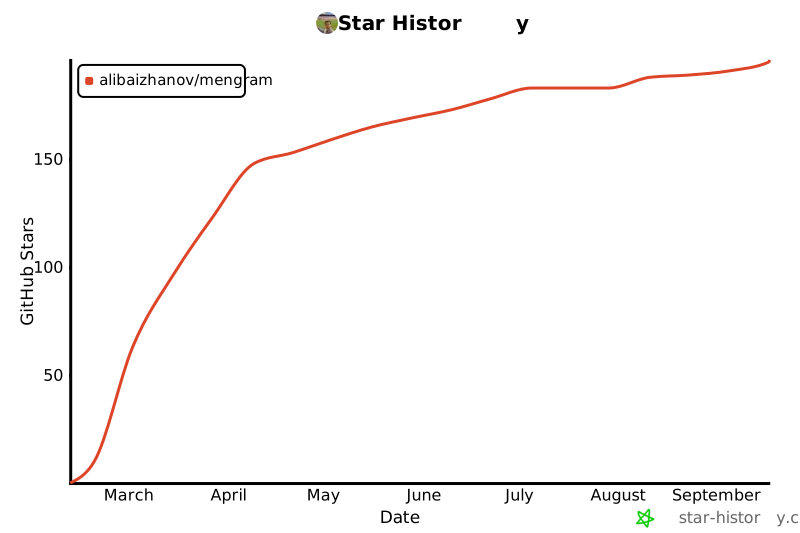
Star History
[
](https://star-history.com/#alibaizhanov/mengram&Date)
License
Apache 2.0 — free for commercial use.
Get your free API key · Built by Ali Baizhanov · mengram.io
Reviews
No reviews yet. Be the first.
Related
Agno
The programming language for agentic software.
Graphify
AI coding assistant skill (Claude Code, CodeBuddy, Codex, OpenCode, Kilo Code, Cursor, Gemini CLI, Aider, OpenClaw, Factory Droid, Trae, Hermes, Kiro, Pi, Devin CLI, Google Antigravity) - turn any folder of code, docs, papers, images, or videos into a queryable knowledge graph
Anything Llm
Server endpoints to process or create content for chatting
mh install mcps/mengram-ai