browser-use-mcp-server
MCP browser-use server library
pinned to #a9864a4updated 3 months ago
Ask your AI client: “install mcps/browser-use-mcp-server”.
Requires the metahub MCP server installed in your client. Set up MCP.
mh install mcps/browser-use-mcp-servermetahub onboarded this repo on the author's behalf.
If you own github.com/kontext-security/browser-use-mcp-server on GitHub, claim the listing to take over publishing. Your claim preserves the existing eval history and badges; only the curator label is replaced with verified-publisher on your next publish.
Stars
823
Last commit
3 months ago
Latest release
published
- #browser
- #browser-use
- #cursor
- #mcp
- #mcp-server
- #playwright
Automated checks the publisher passed at publish time — structure, docs, safety, and whether the artifact behaves as claimed.a9864a4· 3 months ago
Behavioral checks haven't run yet: the sandbox couldn't execute this artifact (it may need credentials we don't provide, or an unsupported build). An environment limit, not a verdict.
Documentation
4 passed1 warningDescription qualitywarn
Only 4 words · 30 chars — more detail helps discovery
Tell consumers what this artifact does in a full sentence.
README is present and substantial
6,281 chars · 11 sections · 10 code blocks
Tags / topics declared
6 total — browser, browser-use, cursor, mcp, mcp-server, playwright
README has usage / example sections
found: Installation · Usage · Example
Homepage / docs URL declared
https://kontext.security
Release history
1- releasecurrenta9864a4warn3 months ago
Contents
Prerequisites
- uv - Fast Python package manager
- Playwright - Browser automation
- mcp-proxy - Required for stdio mode
# Install prerequisites
curl -LsSf https://astral.sh/uv/install.sh | sh
uv tool install mcp-proxy
uv tool update-shell
Environment
Create a .env file:
OPENAI_API_KEY=your-api-key
CHROME_PATH=optional/path/to/chrome
PATIENT=false  # Set to true if API calls should wait for task completion
Installation
# Install dependencies
uv sync
uv pip install playwright
uv run playwright install --with-deps --no-shell chromium
Usage
SSE Mode
# Run directly from source
uv run server --port 8000
stdio Mode
# 1. Build and install globally
uv build
uv tool uninstall browser-use-mcp-server 2>/dev/null || true
uv tool install dist/browser_use_mcp_server-*.whl

# 2. Run with stdio transport
browser-use-mcp-server run server --port 8000 --stdio --proxy-port 9000
Client Configuration
SSE Mode Client Configuration
{
  "mcpServers": {
    "browser-use-mcp-server": {
      "url": "http://localhost:8000/sse"
    }
  }
}
stdio Mode Client Configuration
{
  "mcpServers": {
    "browser-server": {
      "command": "browser-use-mcp-server",
      "args": [
        "run",
        "server",
        "--port",
        "8000",
        "--stdio",
        "--proxy-port",
        "9000"
      ],
      "env": {
        "OPENAI_API_KEY": "your-api-key"
      }
    }
  }
}
Config Locations
| Client | Configuration Path |
|---|---|
| Cursor | ./.cursor/mcp.json |
| Windsurf | ~/.codeium/windsurf/mcp_config.json |
| Claude (Mac) | ~/Library/Application Support/Claude/claude_desktop_config.json |
| Claude (Windows) | %APPDATA%\Claude\claude_desktop_config.json |
Features
- Browser Automation: Control browsers through AI agents
- Dual Transport: Support for both SSE and stdio protocols
- VNC Streaming: Watch browser automation in real-time
- Async Tasks: Execute browser operations asynchronously
Local Development
To develop and test the package locally:
-
Build a distributable wheel:
# From the project root directory uv build -
Install it as a global tool:
uv tool uninstall browser-use-mcp-server 2>/dev/null || true uv tool install dist/browser_use_mcp_server-*.whl -
Run from any directory:
# Set your OpenAI API key for the current session export OPENAI_API_KEY=your-api-key-here # Or provide it inline for a one-time run OPENAI_API_KEY=your-api-key-here browser-use-mcp-server run server --port 8000 --stdio --proxy-port 9000 -
After making changes, rebuild and reinstall:
uv build
uv tool uninstall browser-use-mcp-server
uv tool install dist/browser_use_mcp_server-*.whl
Docker
Using Docker provides a consistent and isolated environment for running the server.
# Build the Docker image
docker build -t browser-use-mcp-server .

# Run the container with the default VNC password ("browser-use")
# --rm ensures the container is automatically removed when it stops
# -p 8000:8000 maps the server port
# -p 5900:5900 maps the VNC port
docker run --rm -p8000:8000 -p5900:5900 browser-use-mcp-server

# Run with a custom VNC password read from a file
# Create a file (e.g., vnc_password.txt) containing only your desired password
echo "your-secure-password" > vnc_password.txt
# Mount the password file as a secret inside the container
docker run --rm -p8000:8000 -p5900:5900 \
  -v $(pwd)/vnc_password.txt:/run/secrets/vnc_password:ro \
  browser-use-mcp-server
Note: The :ro flag in the volume mount (-v) makes the password file read-only inside the container for added security.
VNC Viewer
# Browser-based viewer
git clone https://github.com/novnc/noVNC
cd noVNC
./utils/novnc_proxy --vnc localhost:5900
Default password: browser-use (unless overridden using the custom password method)
Example
Try asking your AI:
open https://news.ycombinator.com and return the top ranked article
Support
For issues or inquiries: cobrowser.xyz
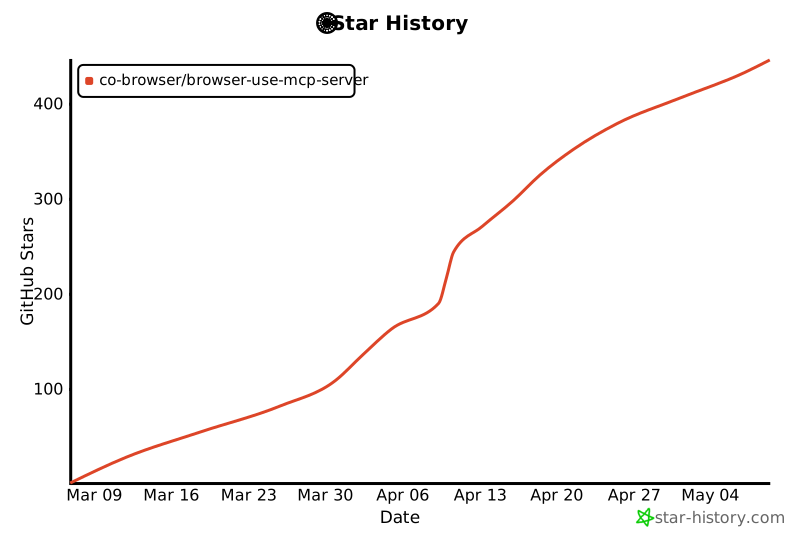
Star History
Reviews
No reviews yet. Be the first.
Related
Playwright Mcp
Playwright Tools for MCP
Github Mcp Server
Connect AI assistants to GitHub - manage repos, issues, PRs, and workflows through natural language.
Context7
Up-to-date code docs for any prompt
mh install mcps/browser-use-mcp-server